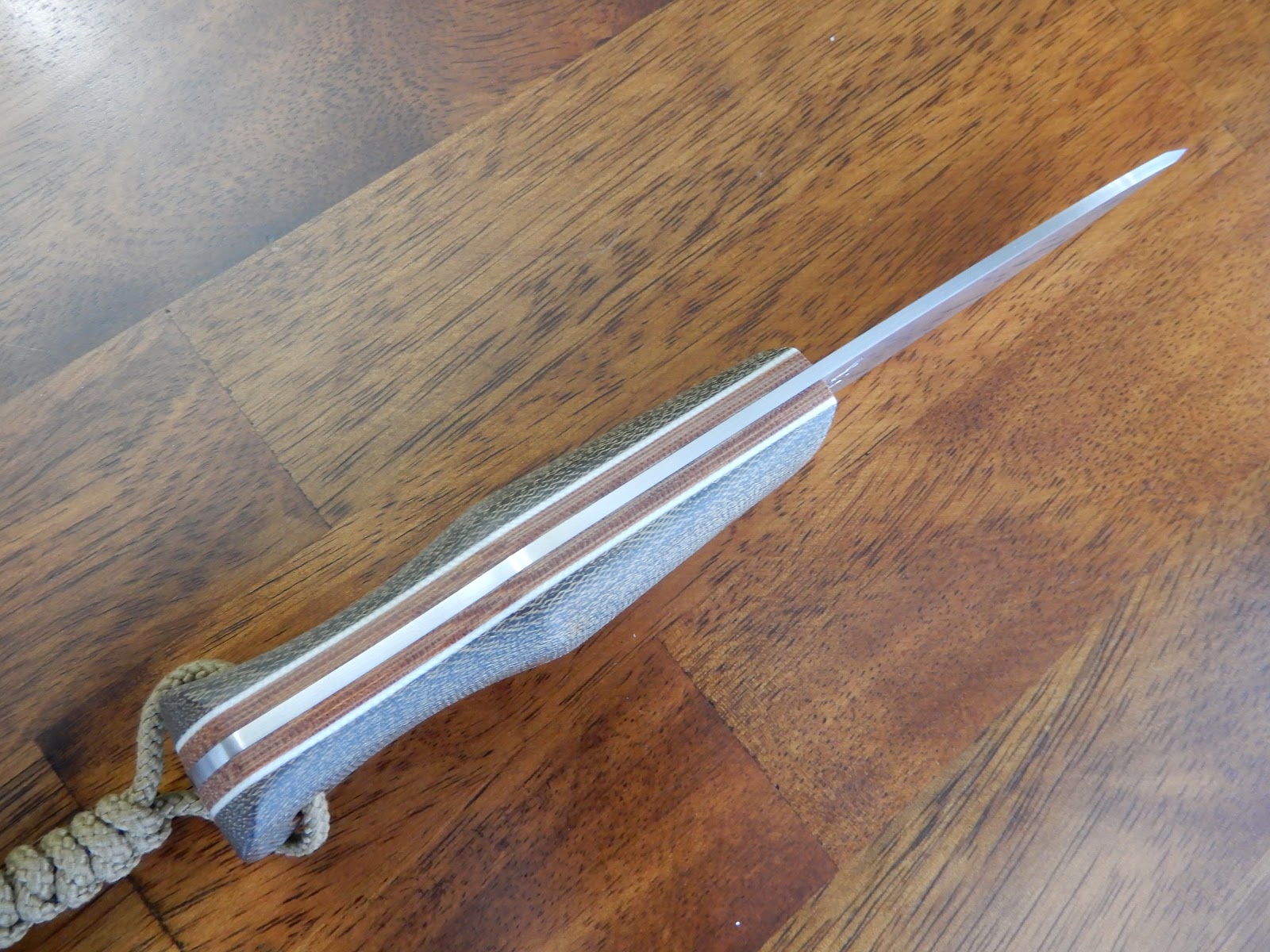
AA Forge knives have quickly become my favorite. The knives are produced by Adam Gray in Trenton, Ohio. He started making knives as a hobby in his parents basement back in 2009.
Maker's Mark
Adam's blades can easily be identified by his maker's mark of an 'A' near the heel of the blade on the right side. The original style marker's mark utilized a more traditional style font. On August 9th, 2014, AA Forge announced changing the maker's mark to more of a cursive style appearance.

Identifying Blade Material
Immediately below the maker's mark is generally a symbol which indicates the steel used to produce the knife. The image on the left above has nothing present below the A indicating the knife is produce with 01 tool steel. The knife on the right above has a dot below the A which indicates it was produced with 52100. More recent knives, like the one below, include a small X beneath the maker's mark which indicates 80CRV2.

Adam has also recently used AEB-L and NitroV. I believe these have both been marked with the small X but I'll need to confirm.
Knife Grinds
Flat
Convex
Scandivex
Scandi
Blade Flats
Knife Models Produced
AA Forge Trapper
This is a AA Forge Mini Trapper which shows signs of use but not abuse. There is some patina on the blade. The blade is 1/8" 52100 steel and insane sharp. The handle is ironwood with what appears to be G10 green liners. The pins are brass mosaic. The knife comes with a handmade sheath which holds the knife but is not as tightly as I tend to prefer.


Mini Bushcrafter
I owned this AA Forge Mini Bushcrafter until recently. The knife is smaller than most with an overall length of 7 3/4" mostly due to the 3" blade. Despite the small overall size, the knife has the super comfortable contoured handle that is common to AA Forge. The handle scales are walnut with thick white G10 liners and brass pins. The blade is a 3" scandi grind in 52100 steel.
The knife fits perfectly in a dark brown Diomedes sheath. The sheath came with the knife and was a very light tan color. I dyed the sheath a darker brown which improved the look considerably.


AA Forge Woodsrunner
This AA Forge Woodsrunner is made from 1/8" 52100 steel with a convex grind. The handle is made from ironwood burl, stabilized navy burlap, with thick micarta liners. The knife is 9 1/8" overall with a 4 1/8" blade.
The handle combination on this knife is incredible. In my opinion, the knife felt a bit large in my hand mostly due to the thickness of the blade (from spine to blade edge). As a result, I found I like using my AA Forge Bushcrafter more.


AA Forge Hunter
This is an AA Forge Hunter with walnut handle, 1/8" green micarta liners, and brass pins. The blade is 4 1/4" 52100 steel with an exceptionally share convex grind.


AA Forge Ridgeback
This is the AA Forge Ridgeback. This particular model is made from 52100 1/8" steel with a convex grind. The handle is walnut, with 1/8" green micarta liners, white G-10 sandwich liners, and copper hardware. The blade is 4 1/8" long with a 4 5/8" handle. This is an exceptional handle combination and is exceptional as skinning deer.


Another Ridgeback made of 52100 high carbon steel (1/8”), ivory paper micarta scales, 1/8” brown micarta liners, and burlap
bolster. Shown with a Badger Claw Leatherworks sheath.


This example of the AA Forge Ridgeback with a blade made from 3/16" 52100 steel and a convex grind. The handle is stabilized curly maple with red liners and brass pins. The blade is 4 1/4" with a 4 5/8" handle for an overall length of 8 7/8"


AA Forge Woodsman
This is a Woodsman made from 1/8" 52100 steel in a scandivex grind. The blade an handle on this on are both 4 1/2" The handle material is bone linen with natural micarta liners. The pins are natural micarta with brass lanyard tube.


AA Forge Mini Woodsman

AA Forge Bushcrafter
This was my first AA Forge knife. The knife has green micarta scales over black micarta liners with black G10 pins. The blade is made of 5/32" 01 tool steel in a flat grind. I ultimately sold this one to replace it with a different AA Forge Bushcrafter with a more ornate handle and 1/8" thick blade.


AA Forge Grunt
Blade: 3.5" 01 Tool Steel (1/8" Thick) w/Convex Grind
Handle: Bocote w/ Natural Micarta Liners & Maroon Sandwich Liners (8" Overall Length)
Sheath: Custom Badgerclaw Leatherworks


AA Forge Hiker
Blade: 3.125" 52100 Steel (3/32" Thick) w/Convex Grind
Handle: Walnut w/ Lime Green Pinstripe Liner (7.5" Overall Length)
Sheath: Custom Diomedes Sheath


AA Forge Forager
Blade: 3" 52100 Steel 1/8" Thick) w/Convex Grind
Handle: Dark Curly Maple w/Natural Micarta Liners & Sapphire Burlap Bolster.
Sheath: Custom Red Rhino Kydex


AA Forge/Hidden Woodsman Woodlore (1 of 15)
Released January 25, 2019 – Limited Production
Run of 15 Knives
Blade: 3/32” AEB-L Stainless Steel Blade
Handle: Green Micarta Scales w/Brown Micarta Liners,
White Pinstripes w/ Copper Hardware
Sheath: Badgerclaw Leather Works