Showing posts with label Axes. Show all posts

Sunday, January 10, 2016

Snow an Nealley Axe on Collins Handle

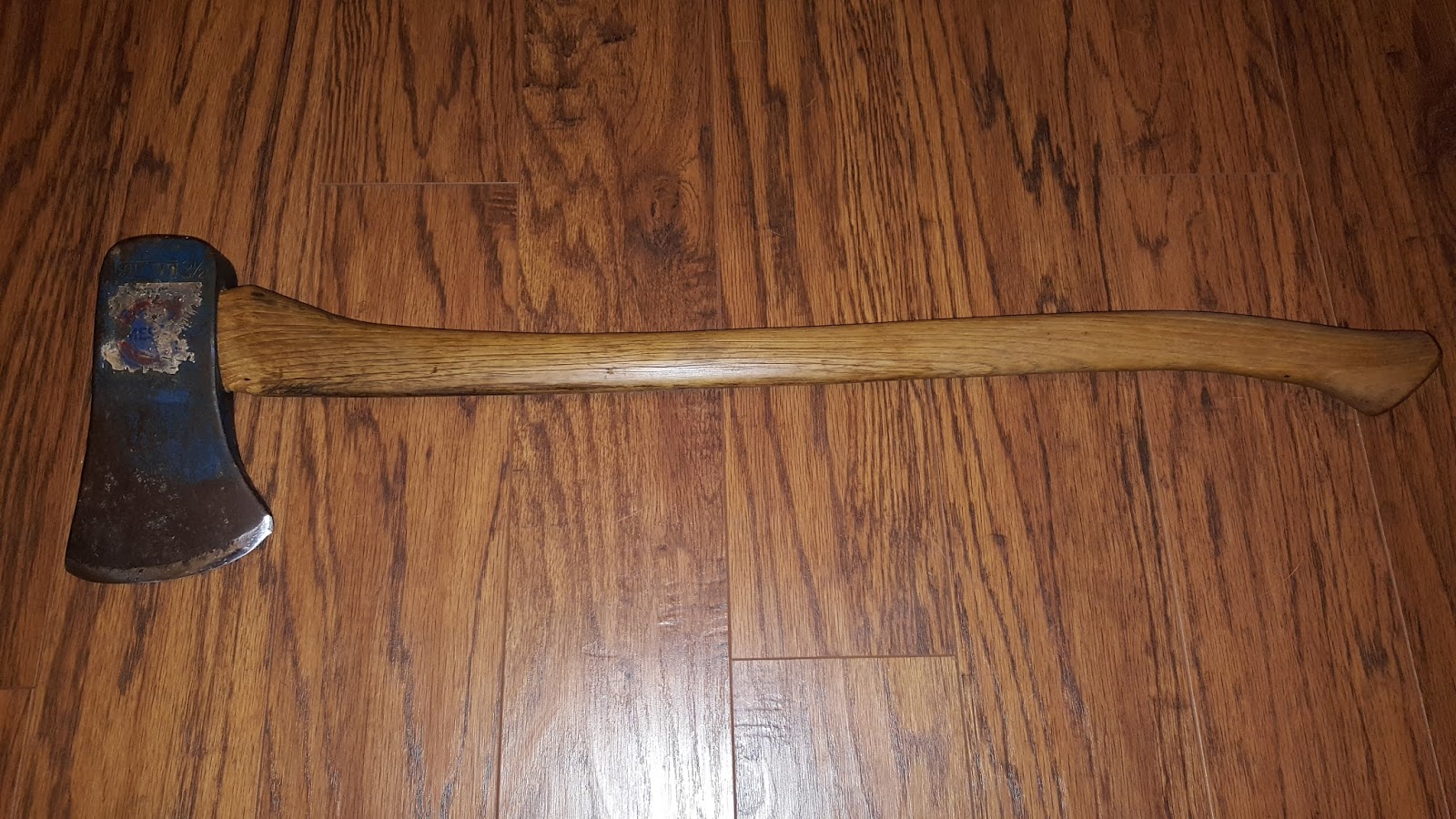
I purchased the following axe at an estate sale in last October 2014.  When purchased the axe head was hung on a 23" long Oregon handle.  The handle was not very comfortable as it was too thin so it was ultimately replaced. 

The head of this axe has a cutting edge which measures 3.5" long.  The head is 6.25" from the sharpened edge to the pole. The pole is 1 5/8" high.  The head is ground with a slight convex 35 degree angle.  The pole has some damaged from being used as a hammer in the past.  

I'm not 100% positive of the maker of this particular axe head.  Under the pole is a "1 3/4" stamp which indicates the weight of the head.  This is a common marking on Snow and Nealley axes.  Aside from that, there are no other identifying marks.  

The eye of the axe head is large so most of the standard size handles were as long or longer than the one I removed.  Luckily, I found an original Collins axe handle on eBay which was exactly the correct size and 17 3/16" long which seemed to be just right.  The fawns foot shape at the end of the handle is a bit extreme for my liking but it is the right length and just the right thickness for a good grip.

The following pictures are of the axe in its current state.  It is exceptionally sharp but needs a sheath make sure it is safe to carry around.  My first attempt as a sheath did not end up as nice as I hoped but I might attempt to make another.


Saturday, January 2, 2016

Norlund Camper Axe


My axe fascination led to the purchase of a Norlund Camper axe.

I broke my rule of only buying the best items possible with this particular axe as Norlund's sell for an incredible amount when in perfect condition.  If you look closely at the following picture, you can see an eye screw in the end of the handle and it appears someone chipped the head and filed just that part of the bit sharp. Since I felt I could fix these items, I purchased it.


The picture above is of the axe as it arrived.  What was not listed in the eBay listing is that the handle was warpped.  It looked as if it had leaned against the wall for many years.  The handle was warpped by about a 1/2"  Otherwise, it arrived as expected.

I straightened the handle which I'll detail in another post.  I sanded the handle smooth with some 220 grit sand paper, and then put on several coats of boiled linseed oil.  I also sharpened the axe some.  The chip in the head is almost completely gone.  I could get it all the way out but right now I'm thinking I'll just use it some before getting it perfect.  This will allow me to use it and ensure the edge retention is as good as expected before just sanding away at the head.


Friday, January 1, 2016

Kelly Flint Edge Cruiser Axe

Before Christmas, I purchased a exceptionally good condition Kelly True Temper cruiser axe head on eBay. While it seems very unlikely, the bits of the axe do not look as if they have ever been sharpened.  As you can tell in the image below, the axe was soaked in vinegar but there must have just been some light surface rust which required it as there are no pits in the metal.


I purchased a 28" white hickory handle from Beaver Tooth Handle Co.  The handle is produced rather well but with pretty good grain orientation.  The cut in the top for the wedge is just a little off center but it should not be an issue with the functionality of the axe.


There was a considerable amount of wood removal required to fit the handle to the head.  I spent a little time over two evenings working on it to get it perfect.  I trimmed it just enough to seat the head and have about 3/16" of the handle stick above the top of the head.  This should leave plenty of handle to drop the head down and refit it if I ever have issues with the head getting loose.


The image below is of the head after seating it on the handle.  There were small curls of handle rolling up around all sides which points to a very tight fit which it great.

I soaked the wedge in boiled linseed oil and then worked it into place.  I made marks on it to see how far I was able to seat it and so that I would know when it was no longer moving.  I was able to put it about 1 1/8" into the head which is quite good.  You can see it was even starting to curl which is another sight of a very tight fit.   


I cut off the excess wedge and left about 3/16" of the handle out the top.  I think the swell of the wood out the top of the head helps a little with head retention.  I'm undecided on the use of a metal wedge.  At this point, I'm going to leave it out.  If it begins to get loose, I'll add one.


This is the final product after several coats of boiled linseed oil.  Additionally, I worked on the head with some fine steel wood and WD-40 to get the carbon residue off from the previous owner's vinegar bath.  The axe is now complete and ready for use!


Put the axe to use shortly thereafter by downing a dead tree which is about 9" in diameter.


Monday, December 28, 2015

What is a Cruiser Axe?

I've recently become more interested in axes and acquired a new cruiser axe.  This then raised the question of why it is referred to as a cruiser axe?

A cruiser is someone who estimates the potential lumber yield from the trees on a tract of land.  This gives the buyer of the timber an estimate of how much to bid on the standing timber.  Theiser would use a smaller axe which could be carried in the woods for days without difficulty.  The axes were used to mark certain trees or the edge of an area.  

From what I understand, the axes were only used until the 1950's.  At which time, trees were marked with cans of spray paint rather than slash marks from a cruiser axe.  After the switch to spray paint, cruiser axes were still used but not as much in the original manner.

A cruiser axe is generally a double bit axe with a head weight of 2.5 lbs and a handle length of 28".  I'm not aware of a company which currently produces cruiser axes.  However, older versions produced by Sager, Kelly, True Temper, Plumb, and others can be found on online auction sites like eBay.  A few examples can be found in this 1937 Warren Tool Catalog.

While I've not read the book, my understanding is the book titled 'Alaskan Adventure' by Jay Williams covers his experiences as a member of the U.S. Forest Service in Alaska and includes some details on the practices of timber cruisers in years past.

Saturday, December 26, 2015

Grandad's Collins Homestead Axe

This year my grandfather turned 92 years old.  On April 5th, we went through a few tools he had which he felt he no longer needed and wanted me to take.  One of them, was a Collins Homestead axe.

The axe was laying on the dirt floor of a shed in a pile of wooden handled tools.  The axe head was rather rusty but otherwise in good condition.  The handle was very dried out and the portion in the head had started to rot such that the head was barely held on.  I decided to take it home and put a little work into it to see how it would turn out.


I removed the head from the handle and spent some time working to clean up the head with WD40 and some steel wool.  The head cleaned up better than expected.  I certainly could have cleaned it better with other methods but I wanted to keep the appearance and the Collins label.

The Collins Homestead label on the axe is a little difficult to see in the pictures as it is faded and scratched up.  However, the following image shows what the label detail better.


With the head removed, I was able to turn my attention to the handle.  I placed the head on the handle numerous times and slowly removed material from the handle allowing the head to fit lower than before.  This took a considerable amount of time but I was able to drop the head down about an inch which allowed me to cut off the rotten portion of wood while keeping the original handle.


I worked on sharpening the head using a few different items.  The grind was still present to I worked with it so that as little material as needed would have to be taken off.  I started with a file, then used sand paper mounted to a flat piece of wood (220, 400, and 1500 grits).  I was able to get to a polished sharp edge but the metal does not need to get as sharp as other axes I've sharpened.  While I expect it to get the job done, I think the metal quality is not as good as my Kelly Perfect or Kelly Flint Edge.

I put several coats of boiled linseed oil on the handle.  The handle has a very nice aged look to it.  This is accentuated by a dark black mark on one side.  I'm not sure what it is but it does not come off with light sanding.  I suspect it is some type of stain which was slipped on it at one point.


My grandad worked at Payless Cashways for a number of years mostly in the 80's.  He purchased most of his tools there at a discount.  Many items he picked up were returned for one reason or another.  I suspect he purchased this there during that period of time as I believe the Homestead line is one of the more recent lines of axes produced by Collins.

I've several good quality axes.  I feel a little bad as I don't use them as much as you would expect but instead just look at them.  Since my brother does not have an axe and did not get many tools from my grandad, I decided to let him have this one.  While it is not exactly a Christmas present, I decided to give it to him when we get together for Christmas this year.  I decided to take pictures and document the axe so I can look back on it as I wish in the future.

I'll end this with a few more pictures of the axe taken today.


Tuesday, December 22, 2015

Inherited Grey Gorge Cruiser Axe

In April of this year, my grandfather turned 92.  Unfortunately, his age has been getting the best of him.  He is no longer able to use the tools he has obtained over the years.  He asked me to go through one of his sheds this weekend to get a few things which I thought I might be able to use.  

On the bottom shelf of a metal rack, behind a lawn mower, I found a cardboard box full of metal brackets and hinges. Buried in the box, I found a double bit cruiser style axe head.  My grandad was not sure of the age but believed it was one which was used in years past by his father.  

The axe has very distinct markings so it is easy to tell the maker. On the side the axe has 'Hartwell Brothers Gray Gorge Memphis Tenn.


From the side view, it is apparent the two sides are not symmetrical.  One side of a cruiser axe is normally not as long as the other side but the difference if fairly minor.  The shorter side of a cruiser axe is normally has a steeper angle to the grind so it can withstand more abuse.  In this instance, this shorter side received a large amount of abuse and was likely ground down over the years to take out chips.

This axe was certainly viewed as only a tool to those who used it in the past.  There are numerous hammer marks along the bottom where it was hammer off and on handles over the years.  


From what I can tell, the axe was produced by Warren Axe and Tool for Grey Gorge which was primarily an handle maker. The axe is referred to as a Cedar pattern axe which I've not heard of before. The source of the information is from 1945 so I suspect it is at least that old but some were made before WW2 (1930's). I've not found much information about the axe beyond this.

I was able to clean up the head using WD-40 and fine steel wool.  I then sharpened up the edges just a bit.  The edges could be done much, much better but my goals was to get them reasonably sharp without removing a great deal of material.  


I installed the axe head on a handle from House Handles.  The head is so worn down, the handle seems very large for it.  The head also seems a little crooked on the handle so I'm not overly happy with it.  I'm not sure if I'll ever try to use it so I'm tempted to take it off the handle and just display it somewhere.  For now, I'll just leave it on the handle and consider it complete.